
Originally published January 2024. Refreshed 20 August 2026: the protocol was re-verified as operating, the leverage figures were reconciled against the live interface, and the claims about staking rewards and HEX's absence from lending markets were dated and attributed. Screenshots are from the original article and are labelled as such.
The PHAME Protocol is a decentralised, non-custodial perpetual exchange on PulseChain — a place to take leveraged long and short positions on PulseChain assets without handing custody of your funds to an exchange. It is a fork of GMX v1, which means its design is well documented and its trade-offs are well understood, including the ones that work against liquidity providers.
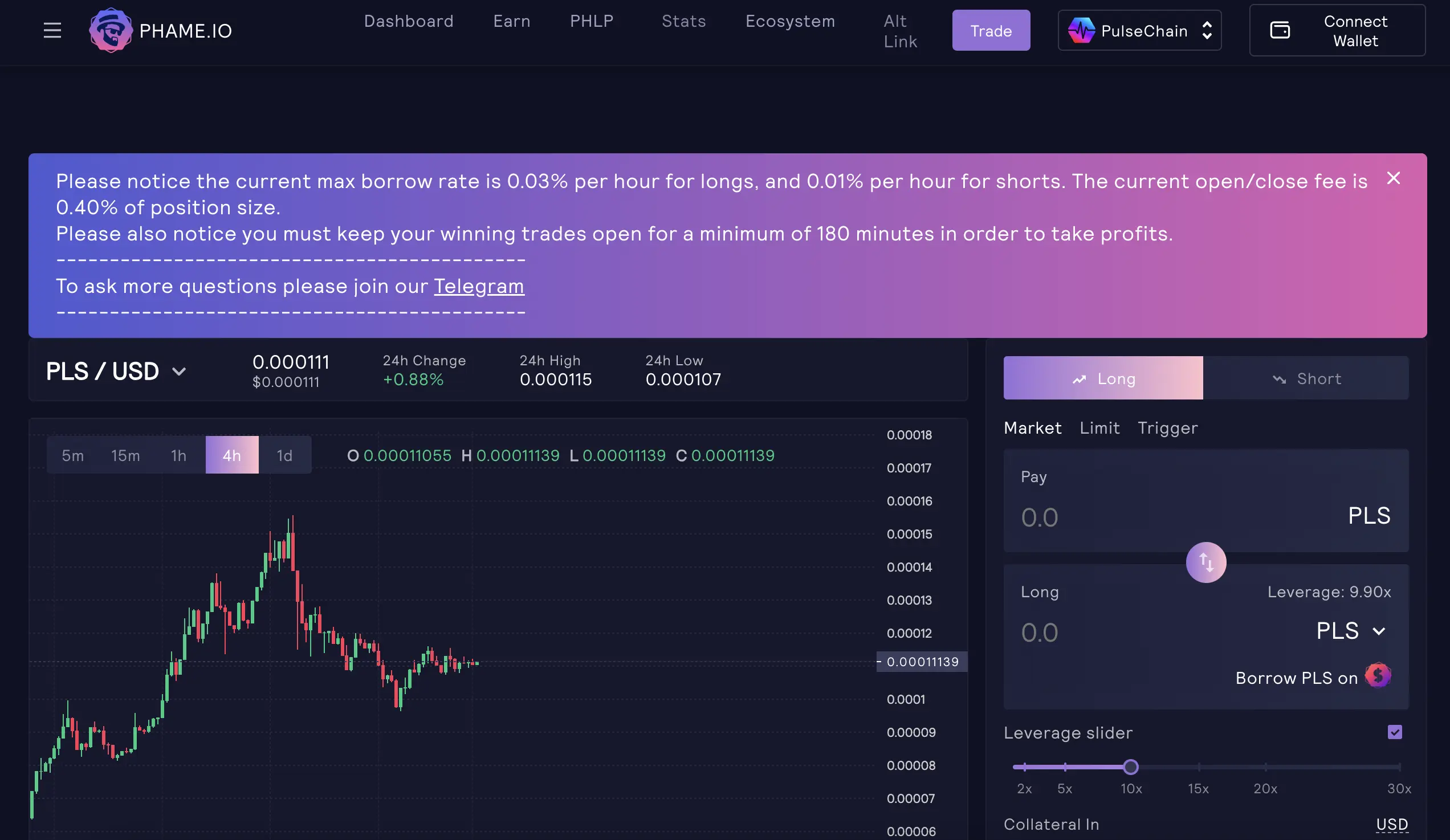
Screenshot from January 2024 — the interface has changed since.
Is PHAME still running?
Yes. We checked on 20 August 2026, and this is worth stating explicitly because a lot of 2024-vintage PulseChain coverage points at projects that have since gone quiet.
The front end at phame.io loads a single-page application, so a 200 response on its own proves nothing — plenty of abandoned dApps still serve a shell. What does prove something is the on-chain record behind it. PHAME's public position subgraph was indexing at PulseChain block 27,334,671 when we queried it on 20 August 2026, with positions both opened and closed within the preceding hour. That is a live protocol with live users, not a parked domain.
Scale is a separate question from liveness. DefiLlama put PHAME's total value locked at roughly $0.67 million on 20 August 2026, which ranked it around twelfth among the PulseChain protocols DefiLlama tracks — a working protocol operating at a modest size.
What is PHAME?
PHAME is a perpetual exchange: traders open positions with leverage and settle them against a shared pool rather than against an order book of other traders. The design goals its documentation states are transparent risk management, low transaction costs, and users retaining custody of their funds until a position is opened.
Traders can take positions on PulseChain assets including PLS, HEX and PLSX. Anyone holding the protocol's PHAME governance token can stake it, and the protocol directs a share of trading fees to stakers.
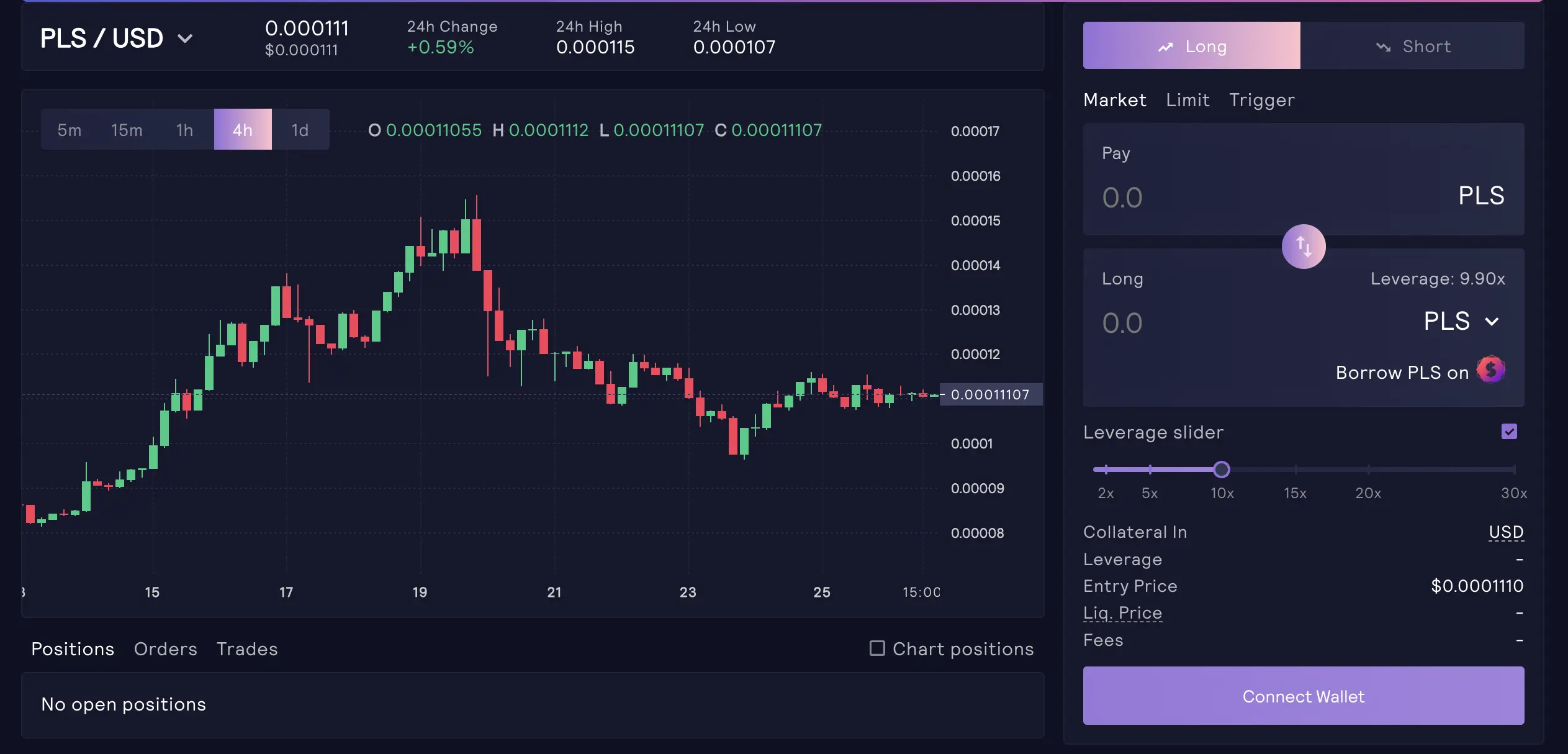
Screenshot from January 2024 — the interface has changed since.
How much leverage, exactly?
The original version of this article gave three different answers to that question — "30x to 50x", "up to 30x to 50x", and "up to 50x" — which is one answer too many. Here is what we could actually verify on 20 August 2026.
- The protocol's own documentation still describes "leverage of up to 30x ~ 50x", and the site's page description advertises up to 50x.
- The trading interface's leverage selector offers presets running 2x, 5x, 10x, 15x, 20x and 30x.
Both of those are facts about how PHAME presents itself, and they do not agree with each other. The reason to spell that out rather than pick the flattering number is that a maximum-leverage setting is a protocol parameter, not a property of the software: it is configurable, it differs between markets, and it can be changed. Treat any figure — including the ones above — as the setting at the moment someone checked it, and read the number the interface gives you when you actually open a position.
Unique features of PHAME
- Customised design: PHAME has its own approach to governance-token staking and to its LP token mechanism.
- Multi-asset pool: a single pool backs trading and earns fees for liquidity providers from market making, swap fees and leveraged trading.
- Community-built: the protocol was built by PulseChain community developers rather than a funded team, with its own tokenomics and LP mechanics.
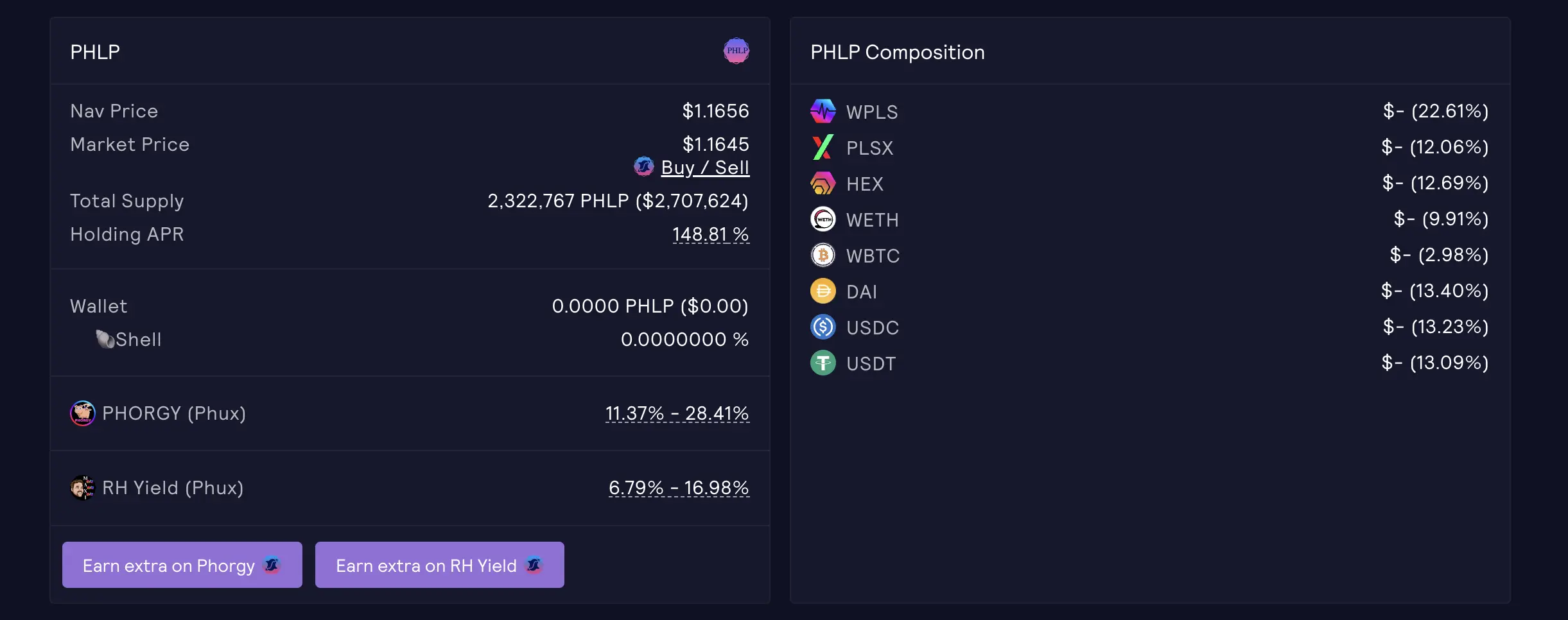
Screenshot from January 2024 — the interface has changed since.
The GMX v1 lineage — and what happened to it upstream
PHAME forked GMX v1, and that lineage cuts both ways.
On the positive side, GMX v1 was one of the most examined designs in DeFi. Its mechanics — a shared multi-asset pool, oracle-priced execution, no order book — were public, forked widely and stress-tested for years.
On the other side, GMX v1 is no longer the live version of the thing PHAME was copied from. On 9 July 2025 GMX v1 was exploited for roughly $42 million through a re-entrancy flaw in its GLP pool; most of the funds were returned under a white-hat arrangement and GMX completed around $44 million in compensation to affected GLP holders. V1 was paused after the incident and set for sunset, with GMX's development moving entirely to V2 (crypto.news, 2025).
That does not mean PHAME shares the specific bug — a fork's contracts are its own, and how a given fork was modified, deployed and patched determines its exposure. It does mean the upstream codebase is no longer actively maintained by the team that wrote it, and that a fork of a deprecated design does not inherit upstream fixes. Anyone weighing risk here should treat "it's a GMX v1 fork" as a reason to look at the contracts and any audit history, not as a reassurance.
Yield and the pool: how liquidity providers actually get paid
Depositing assets into the basket
Liquidity providers deposit assets into PHAME's multi-asset pool — the "basket" — and that pool is what traders trade against. In return, depositors receive a share of the fees generated by market making, swap fees and leveraged trading.
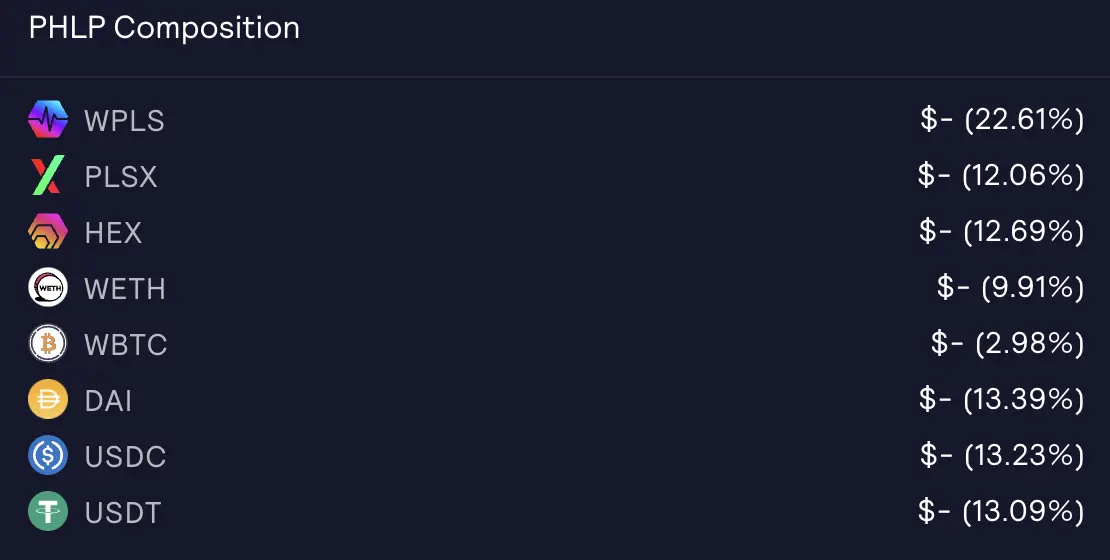
Screenshot from January 2024 — the pool composition changes over time.
The unusual form of impermanent loss
This is the part of the design most worth understanding before depositing anything, because it is not the impermanent loss people know from a normal AMM.
- LPs gain when traders lose. Losses on leveraged positions stay in the pool, which increases the value backing each LP share.
- LPs lose when traders win. Profitable trades are paid out of the pool, which reduces it.
In other words, the pool takes the other side of the traders. Depositing is not a passive fee-harvesting position; it is a directional bet that the traders on the platform, in aggregate, do worse than the pool. Over long periods and across the industry that has usually been a reasonable bet — but "usually" is doing real work in that sentence, and a single well-timed run of winning trades on a small pool moves it a long way.
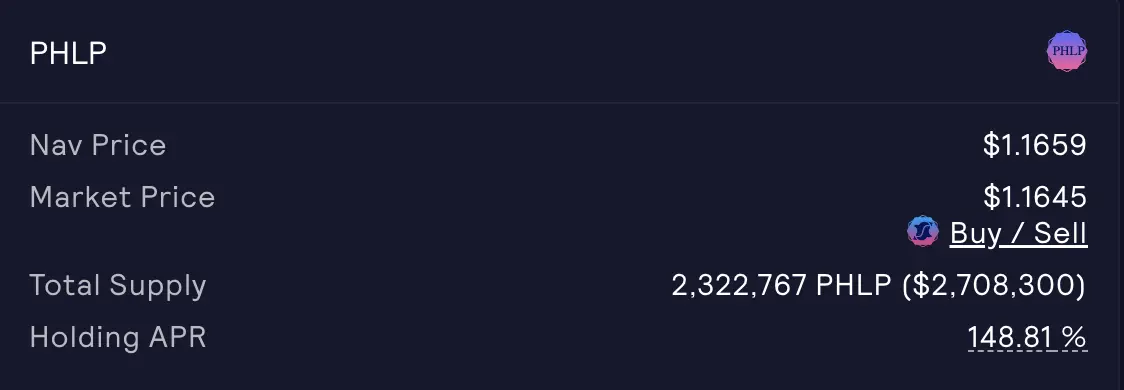
Screenshot from January 2024 — the APR shown was the rate displayed at that moment. Pool APRs on this kind of protocol move with trading volume and with trader profit and loss; they are not a fixed or promised rate, and a figure from 2024 tells you nothing about what the pool pays today.
Staking PHAME and the fee share
PHAME's documentation says that staking the governance token entitles stakers to a share of protocol revenue. We could confirm that the protocol describes this mechanism; we could not independently verify the current split, what it is paid in, or what it has actually paid over any given period, and the documentation we reviewed on 20 August 2026 does not state a percentage.
So read it as a mechanism rather than a return. Fee-sharing pays out of fees, which means it scales with trading volume — on a protocol with under a million dollars of TVL, that volume is small and variable. Any advertised rate is a snapshot of recent activity, not a commitment, and revenue-sharing arrangements set by protocol parameters can be changed by whoever controls those parameters.
The high risks of leverage trading
Caution for traders
Leverage amplifies both directions. A position at 20x is liquidated by a 5% move against it before fees; the same trade at 30x needs barely 3%. On a low-liquidity chain, where a single large order can move a price several percent, that distance is not much of a cushion.
Screenshot from January 2024.
Most leveraged traders lose money
This was in the original article and it stays in, because it remains the single most useful thing to know before opening a leveraged position.
The evidence is consistent across markets and instruments. Reporting on the retail perpetual-futures boom cites figures in the range of 70–97% of day traders losing money over time, and simulation work on high-leverage trading finds liquidation rates above 90% at 25x (Crypto Briefing, 2026). The mechanism is not mysterious: leverage shortens the distance to liquidation, fees and funding accrue against you the whole time you are in the position, and volatility does the rest.
None of that is specific to PHAME — it is what leveraged trading does everywhere. The practical implication is the same one it has always been: only trade with money you can afford to lose entirely, and size positions on the assumption that you will be wrong more often than you expect.

Screenshot from January 2024.
HEX, and the lending-market question
The original article said HEX had been "excluded from major platforms like AAVE for four years". That framing overstated what is actually known, so here is the accurate version.
As of early 2024, when this article was written, HEX had never been listed as a supported asset on major lending platforms such as Aave. We found no evidence that it has been listed on Aave since. But "was never listed" is a different claim from "was excluded" — the second implies a decision that was taken and can be pointed to, and we have not found one. Assets appear on Aave through governance proposals; not being listed is most often the result of nobody successfully proposing it, or of liquidity and oracle requirements not being met, rather than a stated ban.
What that meant for PHAME in 2024 was straightforward: PulseChain's own protocols were the place where leveraged and collateralised markets in HEX and the other PulseChain assets got built, because the large established venues were not building them. That is still broadly the case.
Screenshot from January 2024.
Where PHAME sits in the ecosystem
PHAME occupies a real and fairly unusual niche: on-chain perpetuals for assets that no large venue lists, run by a community team, at a size where the pool is small enough for individual traders to matter to it. Whether that is interesting or alarming depends entirely on which side of the pool you are standing on.
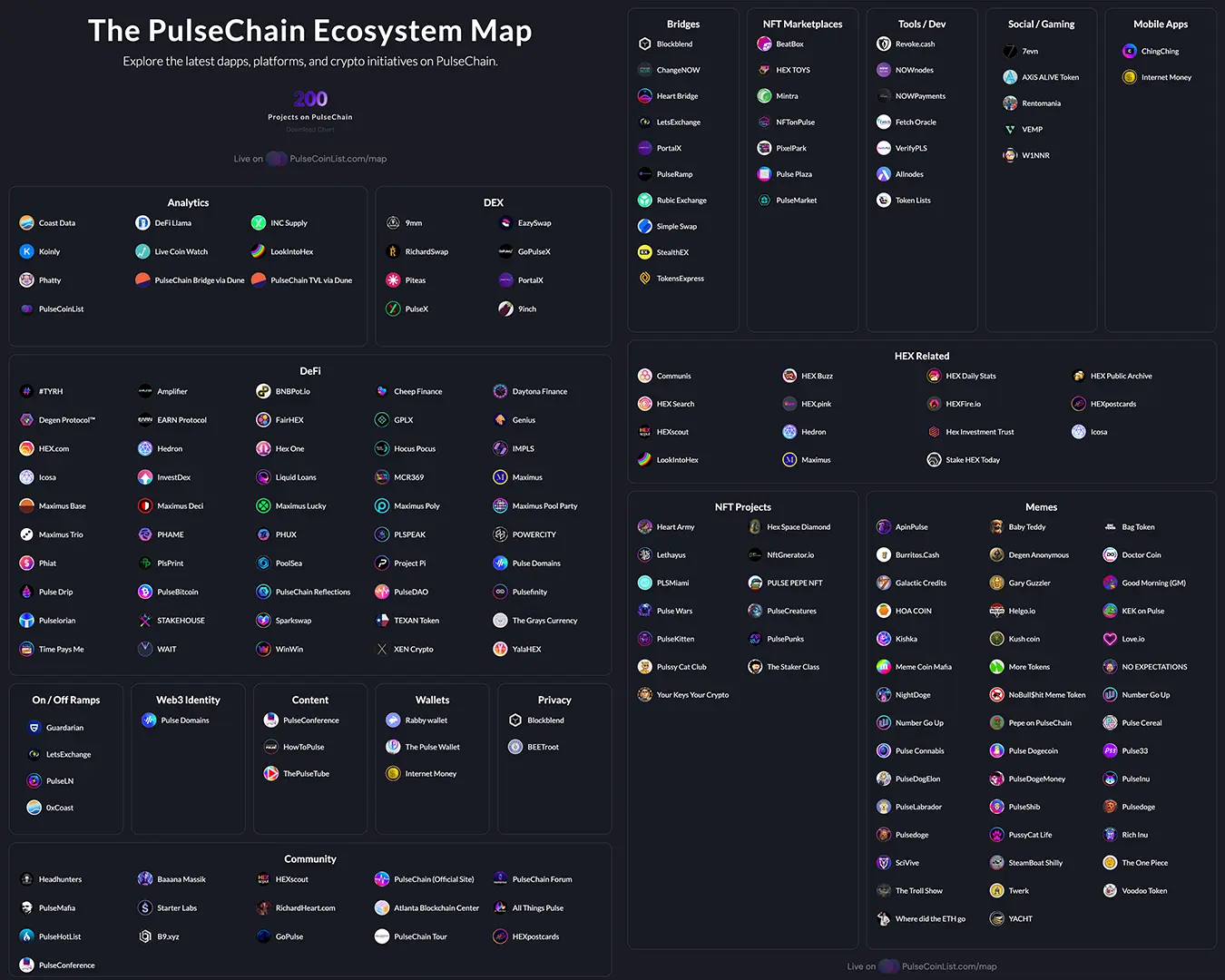
For the wider picture — what else is running on PulseChain, which projects are still active, and what each one does — the PulseCoinList ecosystem directory is the place to browse.
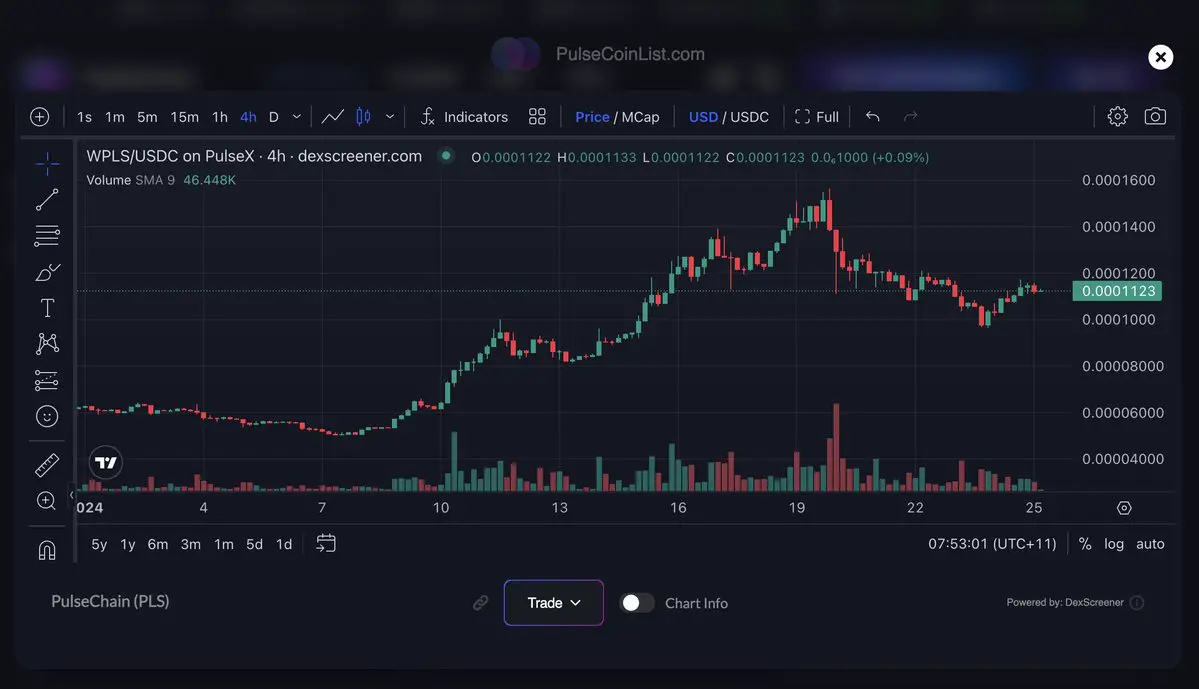
Screenshot from January 2024 — the interface has changed since.
And for live prices, liquidity and market data across PulseChain, PulseCoinList carries the current numbers — which, on a topic like this one, is always more useful than a figure quoted in an article.
Frequently asked questions
Is PHAME still operating in 2026?
Yes. We verified on 20 August 2026 that positions were being opened and closed on the protocol within the hour, via its public position subgraph. Its total value locked at that point was roughly $0.67 million.
How much leverage does PHAME offer?
Its documentation describes up to 30x–50x; the trading interface's presets top out at 30x. Maximum leverage is a configurable protocol parameter, so check what the interface offers when you open a position rather than relying on any published figure.
Is PHAME the same as GMX?
No. PHAME is a fork of GMX v1 deployed on PulseChain — separate contracts, separate pool, separate team. GMX v1 itself was paused after a July 2025 exploit and has been superseded upstream by GMX V2.
What is the risk of providing liquidity to the pool?
The pool takes the other side of traders' positions, so liquidity providers lose when traders win and gain when traders lose. That is a directional exposure, not a fee-only yield, and it sits on top of the price exposure of the assets you deposit.