
Originally published November 2023. Substantially rewritten on 20 August 2026 — the legal section in the earlier version was frozen at the time of writing and had become misleading. Legal status below is stated as of 20 August 2026, with sources and dates.
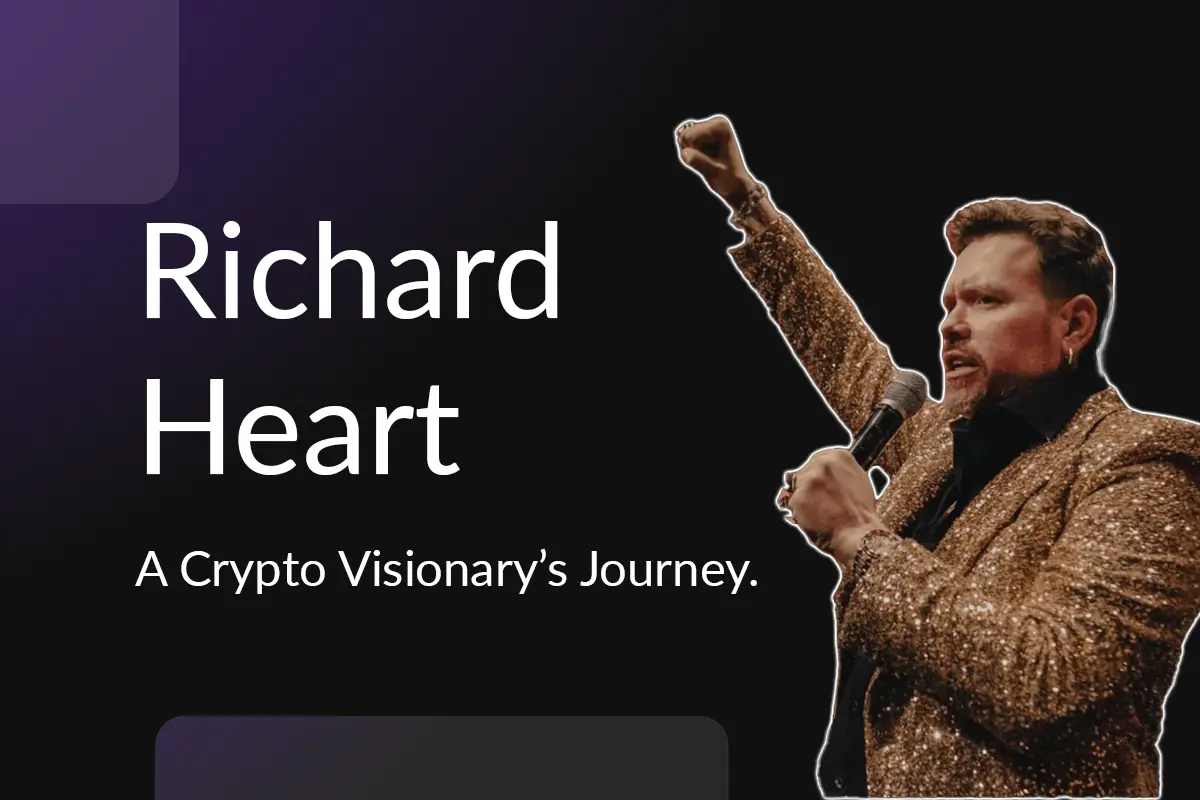
Richard Heart — legal name Richard Schueler — founded HEX, PulseChain and PulseX, and is routinely described as one of crypto's most controversial figures. He has a large, durable following and a similarly durable set of critics, and both groups tend to describe an entirely different person. This article covers what he built, what is verifiable about his background, the criticism, and where his legal position actually stands.
Key takeaways
- Heart created HEX (2019), PulseChain (2023) and PulseX, and built a large community around them.
- Much of the biographical detail in circulation comes from Heart's own accounts and has not been independently verified — it is attributed as such below.
- In February 2025 a U.S. federal judge dismissed the SEC's case against him; the SEC declined to amend and the case closed in April 2025.
- Separately, Finnish authorities have sought him since 2024 over alleged aggravated tax fraud and an assault allegation. Those remain allegations, unresolved as far as public reporting shows.
The formative years
Almost everything known about Heart's childhood comes from Heart himself, mostly through his own streams and interviews. Taken on that basis: he has said he was born and raised in the United States, that his mother read to him early and he was reading by three, and that strong early academic performance moved him from a regular elementary school into a programme for gifted children.

Early life and influences
Heart has said he took part in Project MEGSSS — Mathematics Education for Gifted Secondary School Students, a long-running non-profit programme — where he studied logic, set theory and Scheme programming. He describes himself from that period as "king of the nerds", with an academically focused adolescence.
Other frequently repeated details — a 1390 SAT score, an early career successful enough that he retired at 25 and travelled — come from his own telling and have not been independently confirmed. He has described first jobs in his father's newspaper delivery business and later in air conditioning, and a school friend's computer business as an early influence on how he thought about running one.

The early YouTube channel
Before crypto, Heart's YouTube output was self-improvement material: how to stop gambling, how to stop day-trading, how to spend time on things that scale. It is a useful window into the style that later carried his projects — direct, confrontational, heavy on aphorism.
Some of his earliest videos:
- Stop playing video games, here's how.
- Speak truth to stupid! Speak controversially! The world needs smart people to speak up!
- Saying Left/Right is stupid. Describe your politics like your sandwich toppings!
- How to give a great apology and save relationships!
Entering crypto

By his own account, Heart found Bitcoin through Reddit and bought his first coin for around a dollar, later mining with gaming graphics cards — the standard route for hobbyist miners in the early 2010s. He was an early and vocal participant in the block-size debate, arguing for small blocks and decentralisation.
That background — programming, marketing, an existing audience — is what he brought to his own projects a few years later.

HEX
HEX launched in December 2019 on Ethereum. Heart marketed it as a "blockchain certificate of deposit": holders lock tokens into the contract for a chosen term, and the contract pays them additional HEX at the end of it, with penalties for ending a stake early.
The mechanism is worth stating plainly, because a lot of coverage obscures it. HEX's yield is paid in HEX, minted by the contract. There is no external revenue behind it; the return to stakers comes from inflation of the token plus penalties paid by people who unstake early. Supporters see an elegant, fully on-chain incentive design with no counterparty. Critics see a system whose returns depend on continued inflows, and have said so loudly since launch.
HEX in the market
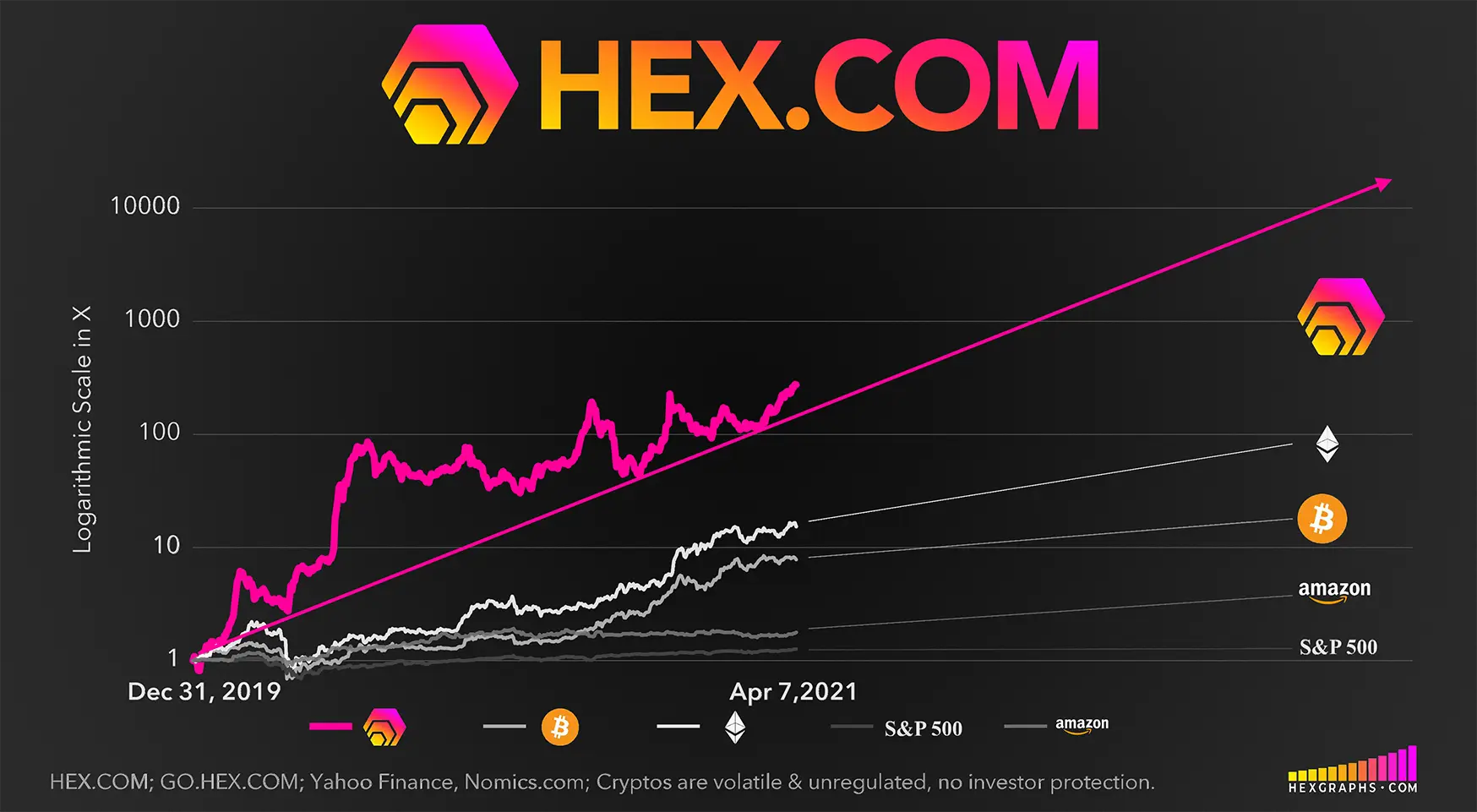
In 2021 HEX rose dramatically and was widely described at the time as one of the fastest-appreciating assets of that cycle. That is a statement about 2021 and should not be read as a description of the token today: it peaked at roughly $0.55 in 2021, and by December 2024 was reported to be trading more than 99% below that high.
Outcomes for holders varied accordingly. People who staked early and exited near the peak did extremely well. People who bought near the top did not. Both facts belong in any honest account of the token.

PulseChain
PulseChain is Heart's second major project: a full-state fork of Ethereum that launched on 13 May 2023. Rather than starting from an empty ledger, it copied Ethereum's system state — contracts, token balances, NFTs — at the fork block onto a separate network, so ERC20 balances held in self-custody appeared as PRC20 copies at the same addresses.
The network runs Ethereum's code with its own validator set and its own, much cheaper block space. One correction to a claim that appears in a lot of writing about PulseChain, including the earlier version of this article: the low fees are not caused by the token's much larger supply. Fee levels come from block space, demand and the fee market; the large supply mostly determines the units fees are quoted in.
The genesis of PulseChain
PulseChain's initial PLS allocation was set through a "sacrifice" phase in 2021, in which participants sent value to designated addresses in exchange for a claim on PLS at launch. Reported totals ran into the hundreds of millions of dollars. It is a distribution model with obvious critics — and it is also the reason PLS was not simply a mirror of anyone's ETH balance.
Impact on the ecosystem
PulseChain's practical proposition is a cheap EVM chain that already contains a copy of Ethereum's contract landscape. That combination gave it an unusually full ecosystem on day one, and it is the thing that most distinguishes it from other low-fee EVM networks. Whether it has sustained momentum since is a question for current data rather than a profile piece — PulseCoinList tracks the live numbers.
Heart's stated philosophy
Heart's public positions are consistent and easy to summarise: decentralisation, self-custody, censorship resistance, transparency of code over trust in institutions, and a general hostility to intermediaries. He argues that if a system's rules are enforced by a contract anyone can read, users do not need to trust the people running it.
Critics accept the principles and dispute the application — pointing out that a heavily promoted token with a founder-shaped narrative sits awkwardly with "don't trust, verify". That argument has been running since 2019 and shows no sign of resolving.
"The Highest of Stakes"

Trailer: https://www.youtube.com/watch?v=KtfjEg_ou6c
"The Highest of Stakes" is a feature documentary directed and produced by Patrick Moreau and Grant Peelle of Muse Storytelling, built around Heart, HEX and the arguments surrounding them. It puts the case for and against on screen — the community, the marketing, the fraud allegations — and lets the tension sit rather than resolving it.
Finance academic Lamont Black appears among the interviewees, providing outside commentary on the token's mechanics.
For where the film is currently streaming, see our dedicated guide: The Highest of Stakes: where to watch. We keep the platform list in that one article so there is a single place to update when availability changes.
Legal status
The following is current as of 20 August 2026. Two separate matters are often conflated: a U.S. civil case, which is over, and a Finnish criminal investigation, which is not.
The SEC case — dismissed in 2025
In July 2023 the U.S. Securities and Exchange Commission sued Heart, along with HEX, PulseChain and PulseX, alleging he had raised more than $1 billion through unregistered securities offerings and had misappropriated around $12.1 million of investor funds on luxury goods, including a 555-carat black diamond.
On 28 February 2025, Judge Carol Bagley Amon of the U.S. District Court for the Eastern District of New York dismissed the case for lack of sufficient connection between the alleged conduct and the United States. The court found that the online statements at issue had been directed globally rather than at U.S. investors specifically, and on the fraud claims held that "the alleged misappropriation occurred through digital wallets and crypto asset platforms, none of which were alleged to have any connection with the United States" (Reuters, 28 February 2025). The SEC was given until 21 April 2025 to file an amended complaint; on that date it notified the court that it did not intend to, and the case closed (The Block, 21 April 2025).
Two points deserve precision, because both camps have been loose with them. The dismissal was jurisdictional: the court held that the SEC had not alleged U.S.-directed conduct, not that the underlying allegations had been tested and found false. Equally, it was a complete end to the matter — no findings were entered against Heart, no penalty was imposed, and the regulator chose to walk away rather than re-plead. Heart's own characterisation, that the SEC "lost", is fair as to outcome; the "fully exonerated" framing that circulated afterwards overstates what a jurisdictional dismissal decides.
The Finnish proceedings — separate, and unresolved
In September 2024, Finnish authorities confirmed a criminal investigation into Heart, who had been living in Finland. Helsinki police said they suspected aggravated tax fraud running to several hundred million euros over the period 2 June 2020 to 2 April 2024, alongside a separate assault allegation dated to February 2021 involving a 16-year-old (Decrypt, September 2024). Finnish police were reported to have seized around 20 luxury watches, valued at roughly $2.6 million, from a residence in Espoo (Cointelegraph, 2024).
In December 2024, at Finland's request, Interpol issued a Red Notice for him and Europol added him to its most-wanted list. He was still listed as of reporting in March 2025, after the SEC dismissal.
A Red Notice is a request that other countries locate and provisionally arrest a person pending extradition. It is not a conviction, and Heart has not been tried on any of these allegations. As of 20 August 2026 we have found no public reporting of an arrest, an extradition or a resolution of the Finnish case. These remain allegations, and Finnish law presumes innocence until proven otherwise.
The criticism
The case against Heart, made consistently by critics since 2019, is roughly this: that HEX's returns are funded by inflation and new buyers rather than any external revenue; that the marketing has been extravagant, with wealth display as a persuasion tool; and that the sacrifice model raised very large sums with limited accountability over their use. "Billion-dollar conman" is the phrase his harshest critics use.
The case for him: the contracts are on-chain, immutable and were audited; nobody was required to participate; PulseChain shipped and works; and no court has found against him — the one regulator that sued lost on jurisdiction and abandoned the case.
Both positions are held sincerely by informed people. Anyone deciding what to do with their own money should read the contract mechanics rather than either side's summary.

The community
Whatever one makes of the projects, the community around them is real and unusually durable. Heart built it the same way he built his early YouTube audience: constant direct communication, simple explanations of complicated mechanics, and a strong in-group identity.
That loyalty has outlasted a 99% drawdown, a federal lawsuit and years of hostile coverage — which tells you the community was never held together by price alone. It also means the projects retain an active user base that most tokens of similar vintage no longer have.
Legacy
Heart's record is genuinely mixed, and stating it plainly is more useful than picking a side. He shipped things: HEX works as designed, PulseChain launched and runs, and the state-copy fork was a technically ambitious piece of work executed in one shot. He also produced enormous losses for people who bought at the wrong time, and attracted the sustained attention of two governments.
He is likely to be remembered less as a technologist than as a case study in how far community, narrative and a well-written contract can carry a project — and in what happens when they run into regulators.
Frequently asked questions
What is happening with Richard Heart in 2026?
The SEC's civil case against him was dismissed in February 2025 and closed in April 2025 when the regulator declined to amend its complaint. Separately, he has been sought by Finnish authorities since 2024 over alleged aggravated tax fraud and an assault allegation, with an Interpol Red Notice issued at Finland's request in December 2024. As of August 2026 we have found no public report that the Finnish matter has been resolved; those allegations have not been tested in court.
Who is Richard Heart?
An American entrepreneur, legal name Richard Schueler, who founded HEX (2019), PulseChain (2023) and PulseX. He is known for a direct, confrontational public style and for a large, highly engaged following.
What is HEX?
A staking contract on Ethereum, launched December 2019, that Heart marketed as a "blockchain certificate of deposit". Holders lock tokens for a chosen term and receive additional HEX at the end, funded by token inflation and penalties from early unstaking rather than by external revenue.
Was HEX really the fastest-appreciating asset?
It rose sharply in 2021 and was widely described that way at the time. That was a 2021 phenomenon: it peaked around $0.55 and by December 2024 was reported to be trading more than 99% below that level.
Has Richard Heart been convicted of anything?
No. The SEC's civil case was dismissed without any findings against him. The Finnish allegations remain allegations and have not been tried.
Where can I watch "The Highest of Stakes"?
Streaming availability changes, so we keep it in one place: see The Highest of Stakes: where to watch.