

Originally published March 2024. Rewritten on 20 August 2026: the protocol was re-verified as operating, every point-in-time figure was either re-sourced or dated, the dead link in the original was fixed, and the return-promising language was removed in favour of a plain description of the mechanics and the risks. Screenshots are from the original article and are labelled as such.
What EARN Protocol is

EARN Protocol is a decentralised borrowing protocol on PulseChain, part of the POWERCITY ecosystem. It does one core thing: it lets you lock PLSX as collateral and draw a loan denominated in PXDC, a dollar-referenced stablecoin, at 0% interest.
It is built on the Liquity design — immutable contracts, no admin keys, no governance, and a very low minimum collateral ratio in exchange for an aggressive liquidation system. That is a specific set of trade-offs, and understanding them is the difference between using this safely and getting liquidated.
(A note on the link: the original version of this article pointed at the www. variant of the domain, which does not resolve. The working address is earn.powercity.io, without the www.)
Is it still running?
Yes. We checked on 20 August 2026. The application loads, and DefiLlama's data for the protocol was updating daily at that point, which means the on-chain positions behind it are live rather than abandoned.
Size is a separate question, and the honest answer is that the protocol is a great deal smaller than it was when this article was first written. See the numbers section below.
How the vault works

You open a Vault, deposit PLSX into it, and draw PXDC against it. The parameters, as set out in the protocol's own documentation and checked on 20 August 2026:
- Minimum collateral ratio: 110%. Your collateral must be worth at least 110% of your debt. Below that, the vault is liquidated.
- Minimum debt: 500 PXDC. You cannot open a vault smaller than this.
- Liquidation reserve: 50 PXDC. Set aside when the vault is opened, and refunded when you close it in good order.
- Borrowing fee: variable, algorithmically set, between 0.5% and 5%. Charged once, on opening.
- Interest rate: 0%. The protocol charges the one-time borrowing fee instead of accruing interest.
The original article described the $500 minimum and $50 retainer as making participation "inclusive and welcoming". They are better read as what they are: a floor that keeps very small vaults out, because liquidating them would not cover the gas. The figures above are the parameters as documented on the date we checked — protocol parameters can differ from documentation and can change, so read them from the interface before you commit funds.
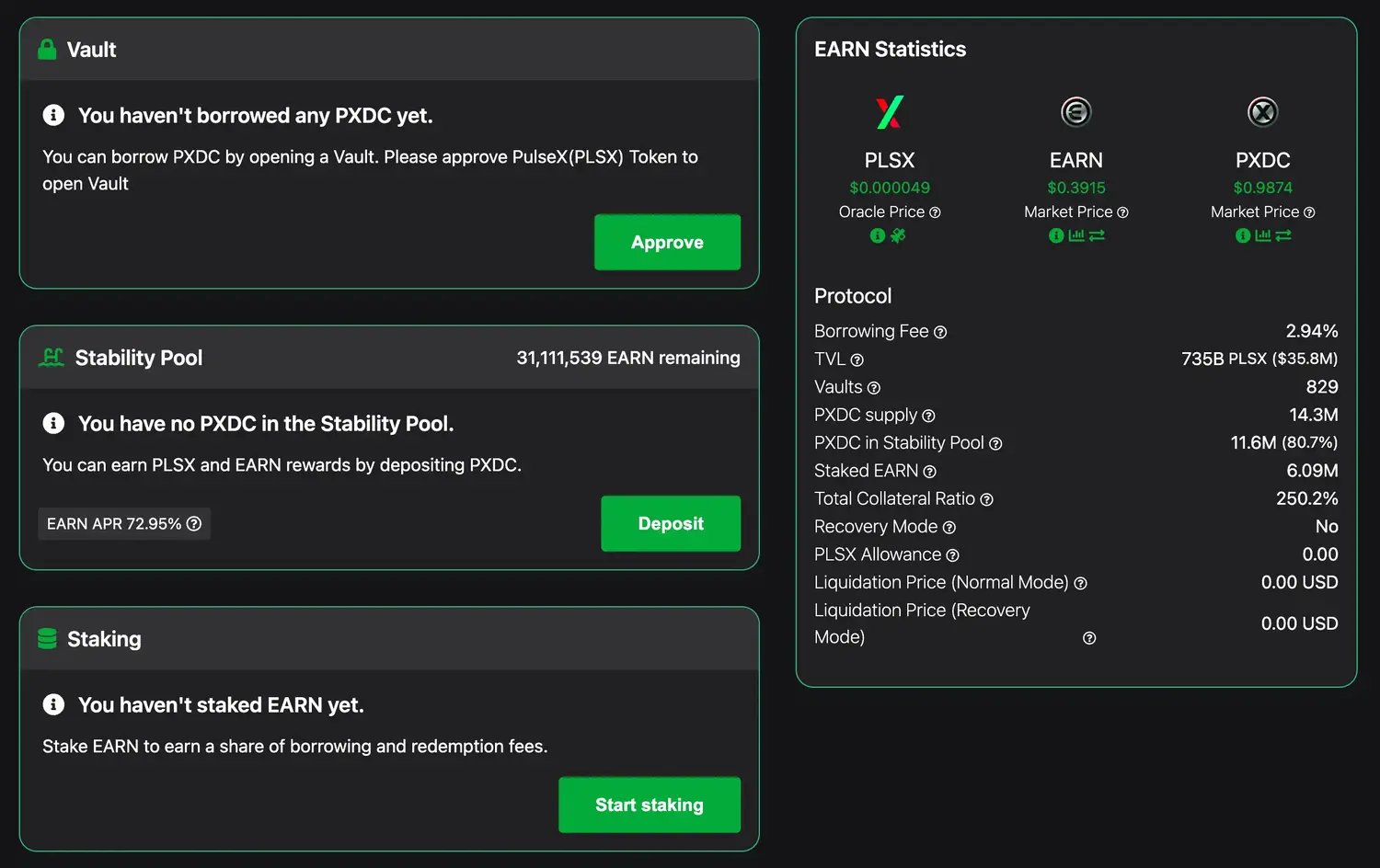
Screenshot from March 2024 — the interface has changed since.
The risk that matters most: 110% is very tight
A 110% minimum collateral ratio means a vault opened at the minimum is liquidated by a 9% fall in the collateral's price. PLSX moves more than that regularly.
This is not a flaw in the design — it is the design. Liquity-style protocols achieve high capital efficiency by liquidating fast and completely rather than by demanding large safety margins. The stability pool absorbs the debt instantly, which is why the system can tolerate a threshold that would break a slower protocol.
What it means in practice for a borrower:
- Borrowing near the minimum ratio is a high-risk position, not an efficient one. Most users of protocols like this operate well above the floor precisely because the floor offers no room.
- Liquidation is not a margin call. There is no grace period and no request to top up. It happens when the ratio is breached.
- You can lose collateral to redemptions even without being liquidated. In this design, anyone holding the stablecoin can redeem it for collateral at face value, and redemptions hit the lowest-collateralised vaults first. Sitting close to the minimum makes you the first in line.
- Recovery-mode dynamics apply system-wide. If the whole system's collateralisation falls below a threshold, liquidation rules tighten for everyone, including vaults that were individually healthy.
Screenshot from March 2024 — the interface has changed since.
PXDC and the peg
PXDC is designed to track one US dollar. "Designed to" is the operative phrase, and it is worth separating the design objective from a guarantee.
The peg is maintained by arbitrage rather than by reserves: redemption at face value gives it a floor, and the 110% minimum collateral ratio gives it a soft ceiling, because anyone can mint at that ratio when the price runs high. There is no company holding dollars behind it and no redemption desk — the mechanism is the collateral and the incentives, and it works to the extent that arbitrageurs act on them.
In practice PXDC trades around a dollar rather than at one. On 20 August 2026 DefiLlama priced it at roughly $1.03, and the PulseChain liquidity pools we checked on the same day showed it between about $1.01 and $1.04. That is a modest deviation and it is above peg rather than below — but it is a deviation, and it demonstrates the general point: a soft-pegged, collateral-backed stablecoin on a thin market is not a dollar. Treat it as an asset that usually trades near a dollar, sized accordingly.
The peg's ultimate dependency is the collateral. PXDC is backed by PLSX. If PLSX falls hard and fast enough that liquidations cannot clear at a profit, the backing behind the stablecoin is what suffers. That is a tail risk rather than an everyday one, and it is the risk that a 0% interest rate is compensating someone for.
Stability pool and staking
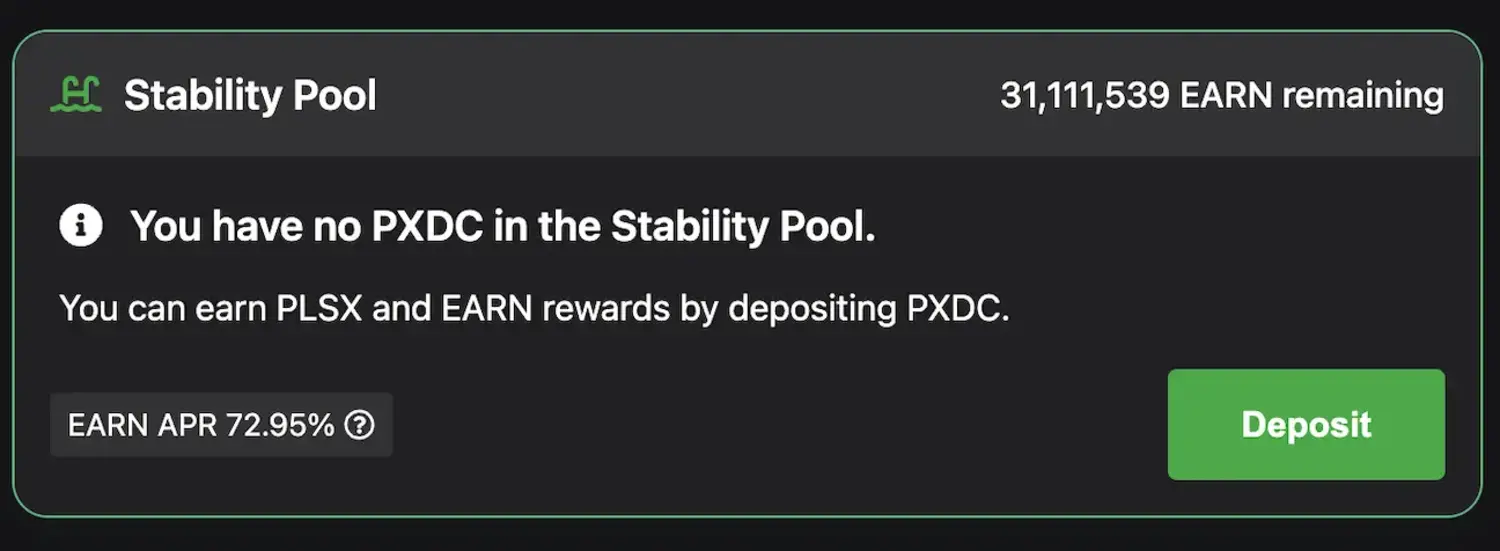
Screenshot from March 2024 — the interface has changed since.
The stability pool is what makes the fast-liquidation model work. Depositors put PXDC in; when a vault is liquidated, the pool's PXDC is burned to cancel that vault's debt and the pool receives the liquidated PLSX collateral. Depositors also receive EARN token emissions.
The important thing to understand is what a stability-pool deposit is: it converts your PXDC into PLSX at moments the protocol chooses, which are moments when PLSX is falling. Historically that has often been profitable, because liquidations happen at a discount — but it is a mechanism that hands you a falling asset by design, and whether it pays depends on what PLSX does next. It is not a savings account.
Staking EARN entitles stakers to a share of protocol fees: PXDC from borrowing fees when new vaults are opened, and PLSX from redemption fees. That income scales directly with protocol activity — when borrowing and redemptions are quiet, so are the fees.
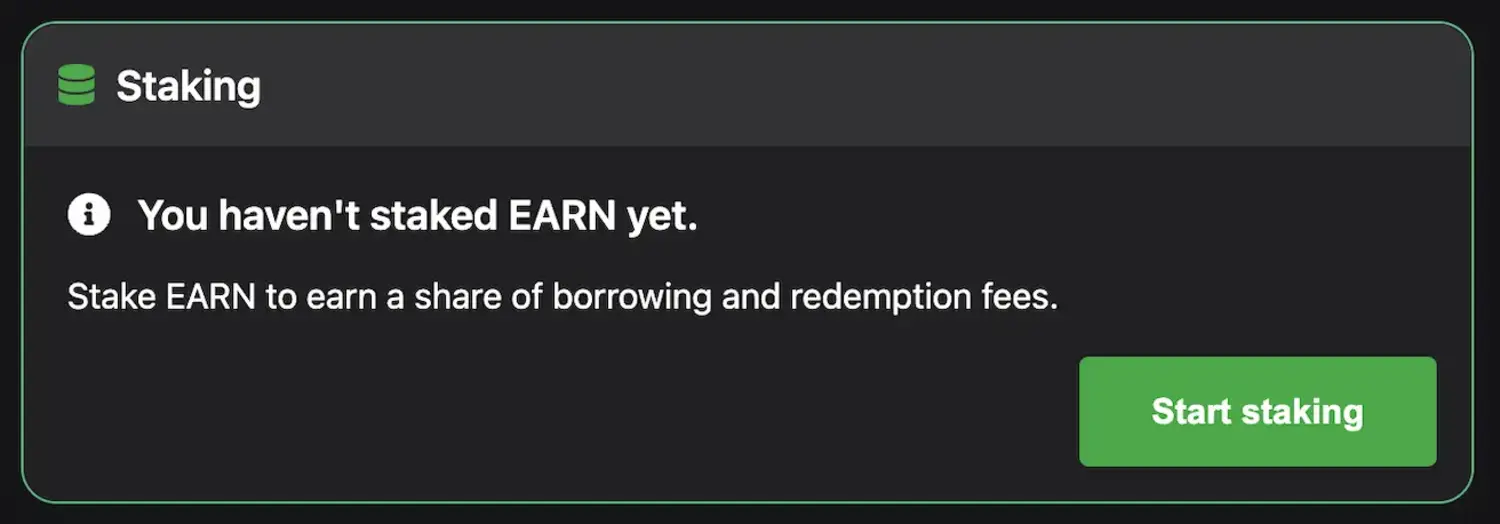
Screenshot from March 2024 — the interface has changed since.
The EARN token itself is an emissions token distributed to stability-pool depositors, with a fixed maximum supply of 100 million and an annual halving of the emission rate.
The numbers, then and now

The original article was written a few weeks after launch and quoted several figures in the present tense. Here they are with dates attached, and with what we could verify today.
Total value locked. The original said "tens of millions". That was accurate for the moment: DefiLlama's data shows EARN's TVL peaking at roughly $39.4 million on 26 March 2024, days after this article was published. On 20 August 2026 it stood at roughly $4.24 million — about a tenth of the peak.
"Second only to PulseX." True at the time, in the sense that EARN was among the largest protocols on the chain during the launch surge. As of 20 August 2026 it ranked fourth among the 58 PulseChain protocols DefiLlama tracks — behind PulseX V1, PulseX V2 and LiquidLoans — and second among PulseChain's collateralised-debt protocols, behind LiquidLoans.
"Number 53 among stablecoins globally." This was the original article's highest-risk sentence, and it was frozen in March 2024. We cannot re-verify the historical ranking. What we can report is the present position: on 20 August 2026, DefiLlama listed PXDC with roughly $0.53 million in circulation, placing it around 209th of the 418 stablecoins it tracks.
Growth in a launch window is not a trend, and this is a clean illustration of why an article should never state a ranking without the date it was taken.

Who this is actually for
Stripped of the marketing language the original article used, the honest description is narrow and specific.
EARN is useful if you hold PLSX, want liquidity without selling it, and understand that you are taking a leveraged long position on PLSX in exchange. A 0% interest rate is genuinely attractive relative to interest-bearing lending markets, and paying a one-time fee instead of an accruing rate suits a borrower who does not know how long they will hold the loan.
It is a poor fit if you are borrowing to buy more of the same collateral — which turns a 9% adverse move into a compounding problem — or if you cannot monitor the position. Immutable contracts mean nobody can bail you out or change the rules in your favour; that is the point of the design, and it cuts both ways.
The original article said the protocol lets users "maximize their returns" and "achieve financial freedom". It does neither of those things. It lets you borrow against PLSX at 0% interest with a tight liquidation threshold. Everything after that is a decision you are making about PLSX.
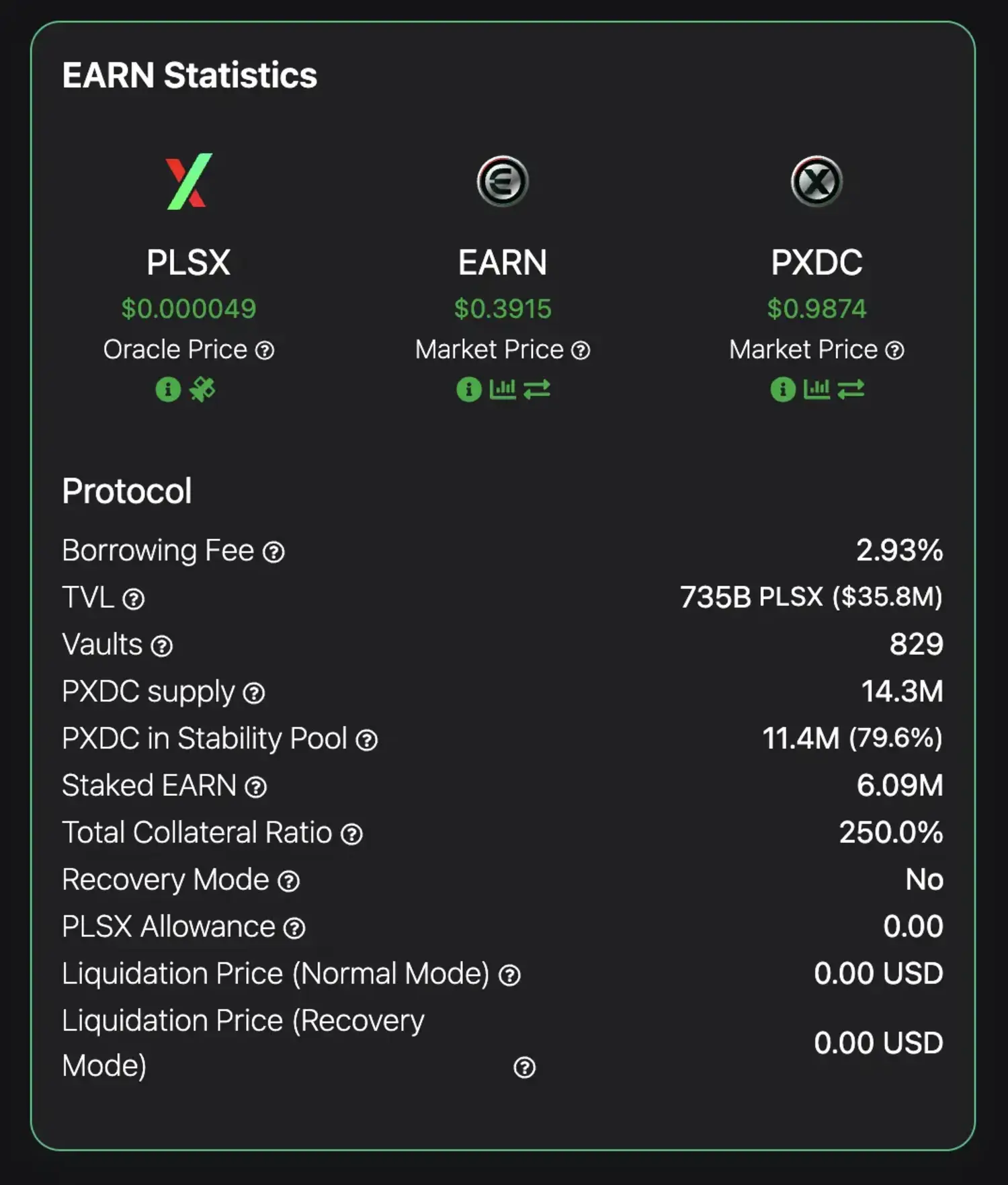
Screenshot from March 2024 — these figures were current at the time of the original article and are now well out of date. See the dated numbers in the section above.
None of this is financial advice. Borrowing against a volatile asset can result in the total loss of your collateral, and depositing into a stability pool exposes you to the asset being liquidated. Read the protocol's own documentation, check the parameters in the live interface rather than in any article, and do not commit more than you can afford to lose.
PulseChain ecosystem
To see what else is running on PulseChain — and which projects are still active — browse the PulseCoinList ecosystem directory. For live PLS, PLSX and network data, PulseCoinList has the current figures, which on a topic like this beats any number quoted in an article.
Frequently asked questions
Is EARN Protocol still operating in 2026?
Yes. As of 20 August 2026 the application was live and the protocol's on-chain data was updating daily, with roughly $4.24 million in total value locked — well below its March 2024 peak of about $39.4 million.
What can I borrow against, and what do I get?
You deposit PLSX as collateral and draw PXDC, a dollar-referenced stablecoin, at 0% interest, with a one-time borrowing fee between 0.5% and 5%.
What happens if PLSX falls?
If your collateral ratio drops below 110%, your vault is liquidated — immediately, with no margin call. A vault opened at the minimum ratio is liquidated by a roughly 9% fall in PLSX.
Is PXDC guaranteed to be worth a dollar?
No. It is designed to track a dollar through collateral and arbitrage incentives, not through cash reserves. On 20 August 2026 it traded at roughly $1.01–$1.04 across the venues we checked.
What is the minimum to open a vault?
500 PXDC of debt, plus a 50 PXDC liquidation reserve that is refunded when the vault is closed properly — as documented on 20 August 2026. Check the live interface for current parameters.